
Story
Editorial by David Landriault
A Tale of Two Galvestons: What the 2025 Housing Numbers Really Show
Luxury surged. Condos slipped. And the middle of the island felt the squeeze.
In this data-driven market recap provided by Sand ‘n Sea , The 1839 examines what really happened in Galveston residential real estate in 2025. While headline numbers show growth, the deeper story reveals a market separating into distinct performance lanes based on location, property type, and ownership cost.
Key Facts
Galveston’s residential market posted stronger headline numbers in 2025, with dollar volume climbing to $486.5 million and total transactions reaching 838 sales. But momentum slowed beneath the surface. Average days on market rose to 86, and the median price edged down to $440,000, signaling a shift from urgency to selectivity.
The defining trend was separation. Waterfront and West End properties surged where scarcity and lifestyle value drove demand. Mid-Island remained steady but financing-sensitive, while condos and attached product softened under layered ownership costs. 2025 was not a weakening year — it was a sorting year.
An 1839 Editorial: February 13, 2026
A Market Divided: Galveston Real Estate in 2025
Galveston’s 2025 housing numbers can be read as a good year: more sales, more total dollars, steady pricing. But read closely—and it starts to feel like a familiar island story with a harder edge: a place prospering on paper while long-time residents quietly carry more of the strain.
Island-wide, residential dollar volume rose to $486.5 million and transactions climbed to 838, up 17% and 15%. Yet the pace slowed. Homes took longer to sell— average days on market rose from 71 to 86 —and the median price eased slightly to $440,000. More movement, less urgency. A market that didn’t fall, but didn’t glide either.
That tension matters because Galveston isn’t just a market. It’s a community with deep roots—people who’ve lived here for decades, raised families here, built careers here, weathered storms here. For them, “a hot market” is not a headline. It’s property taxes, insurance bills, renovation costs, and the uneasy knowledge that the island is getting harder to navigate economically even when you already belong to it culturally.
And in 2025, the island’s housing story wasn’t one story. It was several.
The Island of Scarcity, and the Island of Scrutiny
Start where confidence gathered: the water.
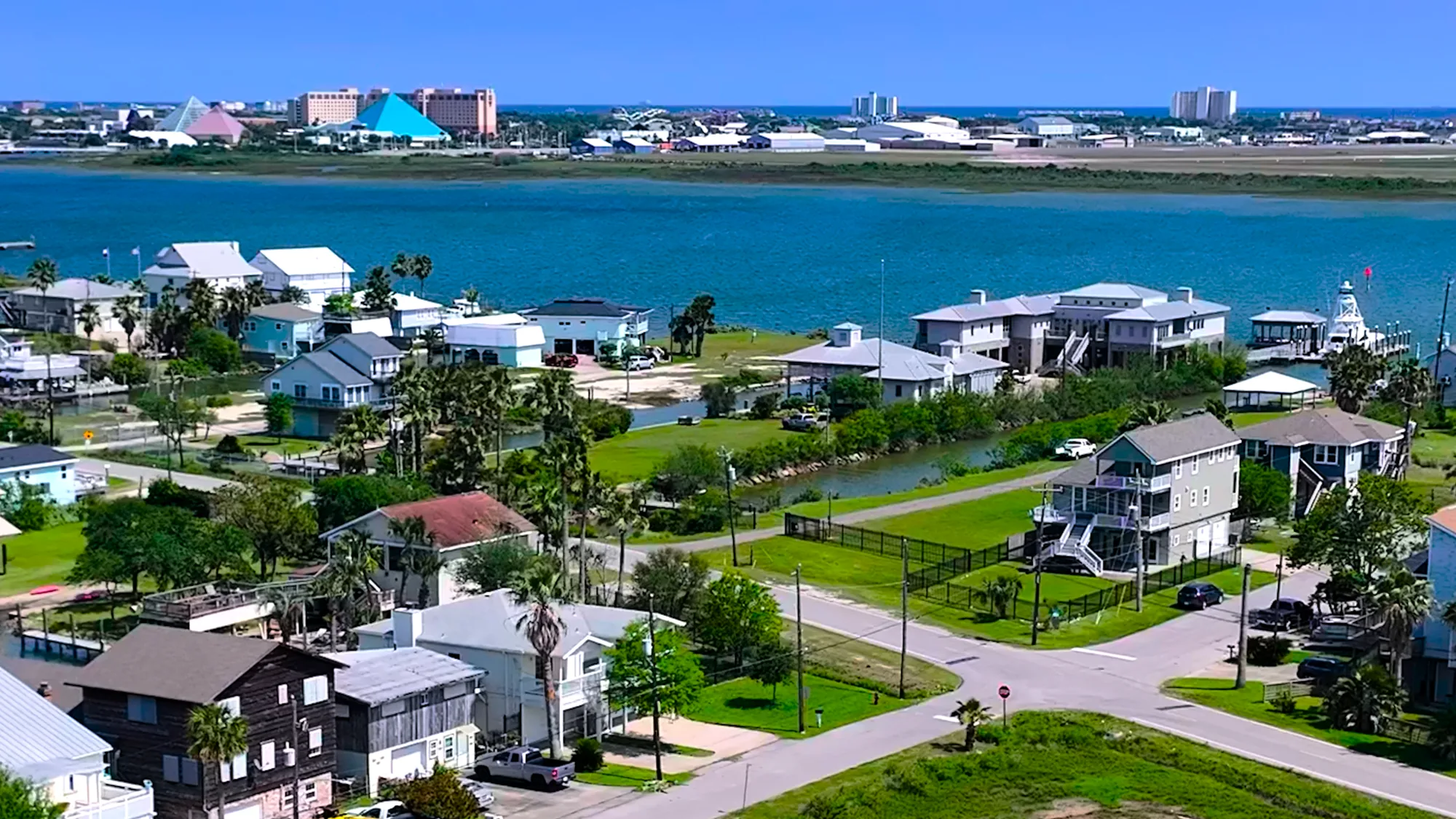
The West End’s beachfront and water-access neighborhoods didn’t just perform well—they separated from the pack. West End Beachfront volume more than doubled. Pirates Cove surged. Canal and bay communities rose. Jamaica Beach gained ground. That pattern, repeated across multiple submarkets, is the signature of scarcity. When the asset is irreplaceable—frontage, docks, water views—buyers stay willing. Even when the broader market slows, the shoreline holds its gravity.
None of that is “bad.” It reflects what makes Galveston special and why people invest here.
But just inland from that strength is another reality: a market moving more carefully, with more friction, and more consequences for the people whose lives aren’t discretionary.
Mid-Island didn’t collapse, but it didn’t run. It held steady. That’s often what you see when buyers are more financing-sensitive: they still want in, but they deliberate longer, negotiate harder, and walk away more often. The rise in days on market is the clearest sign of that shift. The island is still selling—but it’s taking longer to decide.
The Condo Signal: When the “On-Ramp” Softens
Then comes the segment that didn’t merely slow—it pulled back: Downtown/East End lofts and condominiums, where both transactions and dollar volume fell sharply.
That matters because condos and lofts are often part of the ownership “on-ramp” for professionals, first-time buyers, downsizers, and people who want to live close to the core without taking on the full cost and maintenance burden of a detached home. When that segment weakens, it doesn’t automatically prove why—but it does raise a serious question: are the housing options that typically widen access becoming less workable under today’s cost structure?
In a market where detached homes remain the aspiration, condos are often the pressure valve. When the valve tightens, the pressure shows up elsewhere—in longer searches, delayed decisions, and households getting pushed further from the version of island life they were trying to secure.
The Quiet Pressure on the People Who Stayed
This is where the story becomes less about charts and more about Galveston itself.
A rising market can be a blessing and a burden at the same time. Higher values can mean stronger equity—but they can also mean higher holding costs, and higher stakes. And when the market slows, it can leave homeowners caught in between: not eager to sell, not certain they can move, and watching affordability stretch in both directions.
For long-time residents, that’s a particular kind of tension: the island they helped sustain becoming harder to afford—and harder to navigate—without any single moment where it “broke.” Just a series of shifts that add up.
2025, in that sense, was not a crash. It was a sorting.
The shoreline surged. The middle held but slowed. The condo segment blinked. And across it all, the market took longer to make up its mind.
It was the best of times for the irreplaceable parts of the island—and a more complicated time for the parts of the island where people are trying to build a life, not just buy a view.
And that is the real signal in the report: Galveston isn’t failing. But it is changing. And the people who have lived here the longest are often the first to feel the weight of that change—quietly, month by month, bill by bill, decision by decision.
The Clearest Signal: The Market is Taking Longer to Decide
The most telling statistic in the entire recap is not volume or median price. It’s time.
Average days on market rose 21% across the island and 28% on the West End. That’s the market’s way of saying, “We’re still buying — but we’re no longer rushing.”
In practical terms, that shift changes everything:
- Sellers have to price correctly from the start.
- Homes that need work are more likely to sit.
- Buyers have room to negotiate again.
- “Good” listings separate themselves faster from “available” listings.
A market can grow and still become harder. That’s exactly what 2025 looks like: more transactions, but with more sorting and more selectivity.
What 2025 Really Was
If you reduce the year to a single sentence, it’s this:
Galveston didn’t weaken in 2025 — it differentiated.
The strongest demand concentrated where scarcity is real and lifestyle value is undeniable. The middle held steady, but buyers behaved more cautiously. Condos softened, and the overall pace slowed — not because buyers disappeared, but because they gained leverage.
That’s not a headline about collapse. It’s a headline about the end of easy certainty.
And heading into 2026, that may be the defining shift: Galveston remains a market people want — but it’s increasingly a market where what you’re selling, and where, matters more than ever.
Read the full report: Galveston Real Estate Market | Sand `N Sea | Market Trends
Galveston's stories continue.
Get the next one in your inbox →