
Story
Exclusive Editorial with The 1839
The biggest land decision in a generation was scheduled to reach the council June 25. The fight had been loud. The actual choice had barely been whispered.
Written by David Landriault (Founder & Publisher, The 1839)
Outcome update — July 12, 2026: Galveston City Council approved the Discovery Sands PUD request 4–3 on June 25. The 1839’s publisher, David Landriault, watched the vote; the tally is also corroborated by Chron’s June 25 report. This analysis was published before that decision and is preserved below in its original pre-vote context. The City’s public portal currently provides the meeting agenda and an updated proposed-ordinance packet, but no approved minutes; its media page says no video is available, and the attached draft still carries a blank ordinance number. Individual votes, the final ordinance number, and the exact enacted conditions remain pending an official City record.
Everyone's arguing approve-or-stop. The real decision is something else entirely.
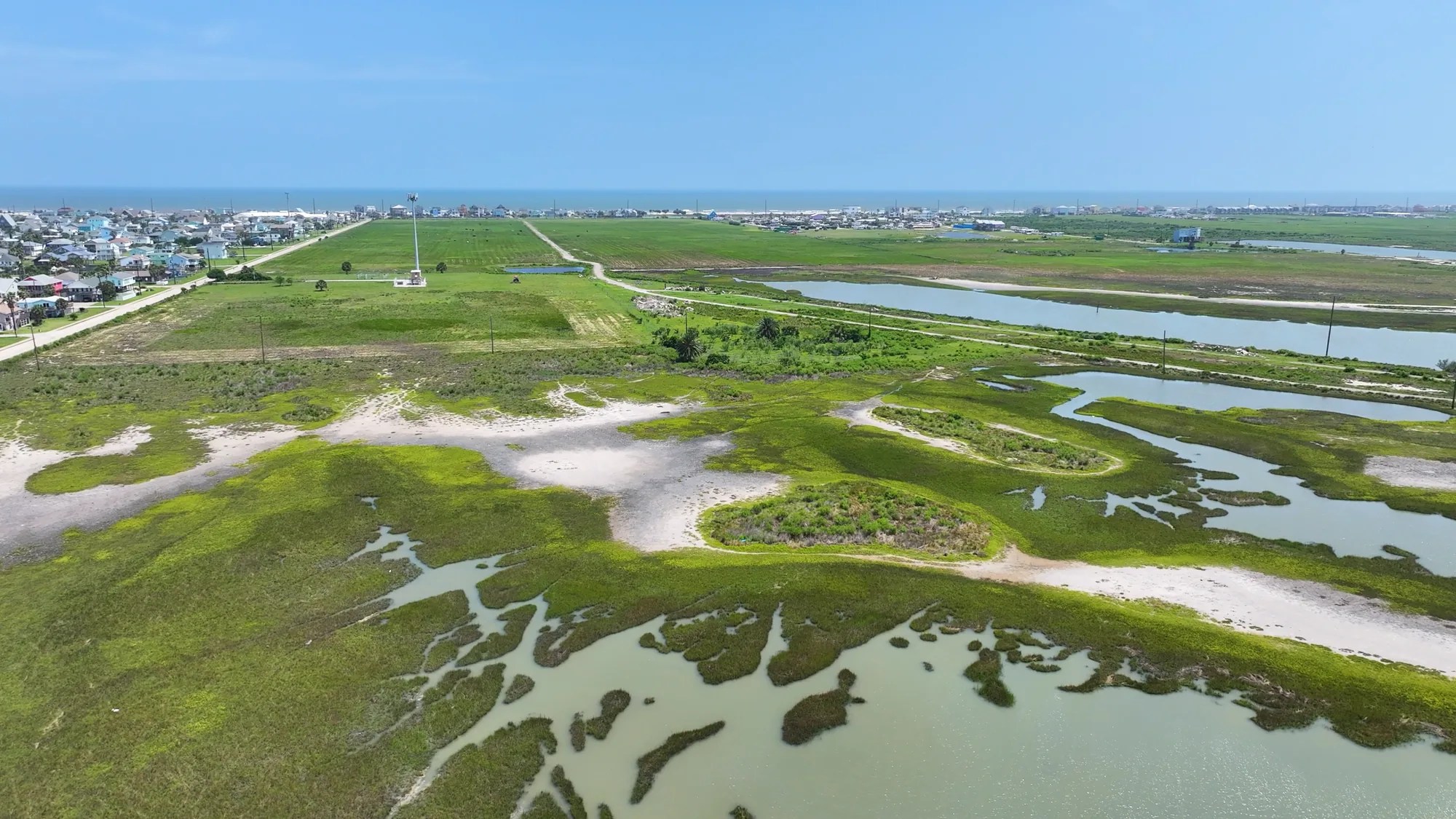
On a foggy morning at the far end of the island, the marsh does something almost no Galvestonian ever sees. The light comes in low off West Bay, and the spider webs appear — one every two or three feet, strung through the cordgrass and glittering, an entire architecture you would swear hadn’t been there an hour before. By midmorning the fog lifts, the webs vanish, and the 351 acres along FM 3005 go back to looking like what most of us register at forty miles an hour: empty land. Salt marsh, prairie, a familiar RV park. Twelve quiet lots near Bob Smith Road that the rest of the West End grew up around and somehow never reached.
On June 25, the city council was scheduled to decide what became of them.
What the developers behind Discovery Sands want to raise there is, by any measure, one of the most ambitious projects in the island’s history: 568 single-family lots — and, under the plan’s own ceiling of six homes an acre, room for close to a thousand residences once the condominiums and townhomes are counted — gathered around a 44-slip marina, a 3.4-acre lagoon, an 1,190-foot lazy river, a surf park, a wedding chapel, and a 120-foot lighthouse. A coastal village on 170 acres of that 351-acre tract, laid over a marsh that drains, channel by channel, straight into the bay.
To its admirers, that is a rare chance to build a more intentional kind of coastal village. To its critics, it is a big bet that risks working marsh, publicly funded restoration, and the West End’s one road out.
It arrives in front of a council that, until Saturday, June 13, did not fully exist. The city council runoffs seated the last two members; the bench is now set — Mayor JP Listowski, with Sharon Lewis in District 1, Jeff Taylor in District 2, Bob Brown in District 3, Alex Porretto in District 4, Michael Niebuhr in District 5, and Jason Hardcastle in District 6. The lame-duck council in place after the May elections could have decided this in May. Residents asked it to wait for one the whole island had chosen, Mayor JP Listowski also urged delay, and, to the developer’s credit, the item was pulled. Now the full seven will take it up.
Jeff Taylor, the new District 2 councilman, says that is exactly why residents pushed to seat a full bench before a decision this size: “This is one of the biggest developments we’ve seen in the 20 years I’ve been here. Why rush and get it wrong? Why not wait and get it right? That’s why it was important to the people that the council wait until the full council was seated. And we work for the people.”
All spring the argument has run on a single rail: approve it, or stop it. But that is not the choice in front of the council, and it is not the choice in front of the island. There are two real paths for this land — and almost nobody is talking about the second one.
Who’s building it
Jeffory Blackard does not show up with a rendering and a prayer. His Adriatica Village in McKinney — a town modeled, improbably and then convincingly, on a Croatian fishing village — is built, occupied, and beloved: hundreds of homes and a walkable town center of shops and offices wrapped around a man-made lake. His companies say they have delivered more than 15,000 homesites across more than 30 projects. The “NeoRetroism” idea behind Discovery Sands — walkable, architectural, organized around places people gather rather than the cul-de-sac — is not marketing he invented for Galveston. It is a thing he has actually built, more than once, and it stands. That record deserves to be weighed honestly, alongside the questions that follow it.
He is no stranger to this island, either. Asked about the “1,000-acre coastal development in Galveston” listed on his own company’s timeline, the Discovery Sands team told us it refers to George Mitchell’s West End portfolio — work Blackard says he helped carry forward after Mitchell, the developer-philanthropist who remade modern Galveston, brought him to the island in 1998. The ground that became Lafitte’s Cove and the Pirates subdivisions traces to those years. To the developer, it is the foundation of a decades-long conservation record, and Discovery Sands is “the most recent chapter of it.”
That telling is contested, and a reader deserves both halves of it. In a Daily News commentary answering Blackard’s own February column, William Broussard — twenty-five years a resident of Lafitte’s Cove — called that reverence for Mitchell into question, and he was specific. He writes that after buying the last of the Mitchell land, Blackard’s first move was to dig an enormous pit, now a lake, between FM 3005 and Stewart Road — an excavation he says pushed neighbors to win a city “pit ordinance.” That Blackard used the pit’s sand to fill wetlands and build the enclave now called The Harbor. And that he built over a dredge-spoils site marked on Mitchell’s own plats, drawing a federal lawsuit in which, by Broussard’s account, the court found Blackard had violated the subdivision maps but declined to order the finished work torn down. The West End history is real, and long. What it says about the man’s stewardship is precisely what’s on people’s minds.
One thing, though, is not in dispute, and it deserves saying plainly: this developer answered. When we sent the Discovery Sands team eight pointed, uncomfortable questions for this story, they returned answers to all eight, on the record, for publication. Our thanks go to Blackard’s executive vice president, B. Jed Rollins, who engaged the hard ones directly instead of declining — his words run throughout what follows, in his own voice. A project willing to be questioned in public is already a better neighbor than one that isn’t.
What’s actually on the table June 25
Here is the part nearly all the shouting has skipped.
The council is not voting on a building. It is voting on a Planned Unit Development — a PUD, case 26P-009 — and a PUD is not a project so much as a private rulebook. It sets aside the city’s standard zoning for one piece of ground and replaces it with terms negotiated between the developer and the city. A yes vote does not approve the pictures on the website or in our heads. It approves the rulebook. And everything that ever rises on those 170 acres will be measured against the rulebook, not the pictures.
So the question for the council is not “do we like this project?” It is the colder, more lasting one: is this a good rulebook?
Read it straight from the city’s own staff report — which anyone can download, and everyone should. Across the project’s interior, it would erase minimum lot sizes, lot widths and depths, and front, side, and rear setbacks. It would trade away the city’s standard parking and screening rules for the plan’s own. It would raise the maximum building height from today’s 50 feet to as much as 70 feet in one planning area and 120 feet in the tallest. It would scrap the signage rules, though the billboard ban survives, and permit private streets. And it would open the ground to a remarkable sweep of uses — more than fifty of them, spelled out in the plan’s Exhibit E, running from homes and condominiums clear through to hotels, a hospital, bars, and an arena or stadium. The one limit it volunteers is on density: no more than six homes an acre across the whole property.
One carve-out matters, and the developer was quick to point it out. The planning area along Bob Smith Road — the edge closest to the Jamaica Beach homes, the nearest neighbors this project has — was revised to conform to the existing R-1 zoning already in place there, adding no height, no density, and no setback deviation beyond what today’s rules allow. For the people living right up against the site, the developer says, the standards governing the ground next to them do not change.
To be fair to the plan, it has shrunk since March, and under real pressure. The developer cut the lighthouse from 159 feet to 120, dropped his bid to escape the city’s lighting rules altogether — promising now to meet and exceed them — and added a three-part planning-area structure that satisfied the Fire Marshal enough to withdraw his objection. A PUD is a trade, and this one has traded in both directions.
What a council can still ask for is in writing. Some of the environmental commitments are already headed into the binding document: the Planning Commission’s recommended conditions include setting aside a conservation area, and the developer notes that it is a term of the PUD plan the Council will vote on, not a side letter. Others still live in narrative and consultant letters — the specifics of the federal wetlands delineation, the pledge to build around the marsh, the offer to help restore the Jumbile and J Cove salt-marsh sites nearby. On 351 coastal acres laced with tidal wetlands, those are exactly the promises a council can move from a letter into the rulebook itself.
The plan also lets city staff sign off on later “minor amendments” without a fresh hearing. The developer conveyed that this is standard PUD administration, written with the city’s own staff, and says the call stays with the city: “The discretion sits with the city, not with us.” That’s true, but it is still the kind of language a council can define more tightly if they choose to do so.
City Manager Brian Maxwell, who is careful to note that staff makes no policy and that he was speaking only to procedure, laid out what Thursday actually decides:
“City staff is not part of the policy-making body that will decide the vote on Thursday. City staff is the keeper of the rules laid out in the LDRs, the administrator of the PUD process and the council’s eyes and ears for implementation of what final agreement occurs between council and a developer. In the current LDRs, there is not an option to prohibit development of this property. There are instead guardrails that a developer must stay within. The true debate on Thursday is not whether Discovery Sands can occur — that vote already occurred when the LDRs were approved — but rather the vote on Thursday is more about if the council wants to alter the guardrails through agreed-upon changes. It’s also a discussion about if all involved are satisfied with what the city will get under the current rules, or can we get a better product that also addresses the concerns brought forward by both our residents and the developer. Oddly enough, it’s an opportunity for discussion and debate that only exists because the developer wants to deviate from the current LDRs — otherwise the die is cast for what can occur on this property with the 2015 LDRs.”
Mayor JP Listowski, who has met with the developer repeatedly as the plan was pared down, sees the vote pragmatically: “He could build out there by right tomorrow without asking the city for anything. Instead he came to Planning, went through two rounds of revisions cutting his variances back, and now it’s at council — that’s the PUD process doing exactly what it was built to do. I’d rather negotiate a few variances for a development that works than force one that doesn’t. The lasting fight — open space, protections that hold — isn’t this project. It’s the LDRs and the comprehensive plan, and we’re rewriting them right now. In the past, we have come to the table in a time of need; it’s time we got proactive. But you don’t change the rules in the middle of the process.”
Path A: The PUD, with real conditions
If the council says yes, it does not have to say yes to the plan as drawn. Conditions written into a PUD are not suggestions; they are enforceable zoning law for that ground. This is where a council holds far more cards than the yes-or-no framing admits — and where a few promises already sit.
On April 7 the Planning Commission recommended approval with four of them: that the council accept the applicant’s offer of 15 workforce-housing units; that a conservation area be set aside; that the sewer-plant site be no smaller than five acres; and that the biggest planning area’s minimum lot size match the city’s R-2 standard. The developer makes a point of where that housing promise lives: “Workforce housing is in the PUD,” Rollins told us. “It’s binding and the city enforces it. That’s the right place for a land-use commitment.”
Rollins handles short-term rentals differently, and on purpose: those limits live in the community’s recorded covenants, enforced by the property owners’ association rather than in the PUD. “POA enforcement is faster and more direct than municipal code enforcement,” Rollins said, “and first-lien authority gives it real teeth.” It’s worth knowing that STR rules can be written into zoning or a PUD — other Texas cities do exactly that, and Galveston’s own STR ordinance applies here regardless — so covenants are a choice, not a necessity.
The wastewater plant the developer frames as a neighborly gesture, sized to pull nearby homes off failing septic. City staff lay out the scope plainly: under state rules the developer must handle his own development’s wastewater; taking surrounding homes off septic is a negotiating point the city can ask for, not a requirement the plan imposes. Even with spare capacity built in, hooking those homes up would carry its own cost — the city covering the right-of-way, each septic owner paying to connect. The plant can be sized for it; how the island gets there is a separate question from Discovery Sands.
Not every councilmember is sure those conditions will bite. Bob Brown, the District 3 representative and one of the council’s closer students of land-use law, says the plan’s promises worry him precisely because they are promises: “I equate PUDs with a negotiation, and it is a negotiation — but they didn’t define what workforce housing means, or how we’re going to follow up on it. I need a greater level of confidence that these deals we’re making are actually going to happen.”
So what else might the island reasonably put on the table? From what residents have raised at the hearings and in the community groups, a starting list:
- Drainage bonded, above the baseline. The city’s Drainage Design Criteria already bind this site, PUD or no PUD; the developer’s engineer, Marcus Michna, says the project will be built to meet them — the 25-year storm standard, the city’s runoff rates, plans sealed by a licensed engineer — and that the design “will not intentionally direct stormwater runoff onto adjacent properties.” The island’s ask could be for more than that floor: drainage bonded and written into the PUD, so the promise carries consequences if it fails.
- Wetland commitments in the PUD itself, matched to the federal delineation.
- A traffic and evacuation study, with road improvements tied to what it finds. No one expects a single developer to fix FM 3005 — it’s the state’s road, and it would cost millions — but the West End has one road out, shared with everyone west of the seawall, and a study is the first step: it shows what the growth actually demands and gives the city the case to press TxDOT before the road is overwhelmed, not after.
- Public bay access — this site fronts the bay, not the beach: launch points, marina public-use terms.
- Phasing tied to infrastructure — so the houses never outrun the pipes and roads meant to serve them.
Scott Hickman, a Galveston charter captain, fisheries advocate, and former District 6 council candidate, argues that this is exactly where the city’s leverage matters: not simply in saying yes or no, but in deciding what Galveston gets in return. “The devil’s in the details,” Hickman told us. “If somebody wants to develop something, which they’re going to do anyway — and I used Discovery Sands as an example — if they want a variance, you make them build a bird nesting island. If they want another variance, you make them build a living shoreline, or seed a new oyster reef. You utilize these assets that they want to invest to improve the marine ecosystem.”
That is a starting list, not the island’s. We are asking readers to build the real one — the question is at the end of this story. And one sober footnote: a PUD approval is not forever. A building permit must issue within 24 months, or the entitlement lapses. Whatever the council approves, the clock starts that night.
Path B: No deal
Here is the path almost nobody is talking about — and, notably, the one the developer himself leads with.
“The premise of most coverage is that Discovery Sands is asking the city for something,” Rollins wrote us. “It’s the reverse.” His case: the land is entitled today, under current zoning, for substantially more than the team has drawn — buildable “with no hearing, no council vote, and no community input” — and the PUD is the developer choosing to build less, in the open, with commitments the bare zoning never demanded. He puts the choice in his own terms: “We chose the harder path: a public process, lower density, preserved wetlands, a wastewater facility sized to take neighbors off failing septic systems, and commitments we’d be bound to keep. That’s not a developer extracting a concession. That’s a developer volunteering to do less, in public, on the record.”
It is the developer’s framing, of course — but it is also largely how the law works, which is why it deserves a straight answer rather than a reflex. Developers tend to carry two plans. Plan A is the premium one, the version that needs the PUD: the architecture, the amenities, the lagoon. Plan B is what gets built by right if Plan A dies — and Plan B is often denser and plainer, not grander. More lots. Fewer flourishes. None of the negotiated extras. It isn’t always so. But a by-right build is always unconditioned: no bonded drainage, no public-access guarantee, no phasing, nothing the island asked for — because under Plan B, nobody has to ask the island anything. City staff confirm the premise rather than soften it: the property can be built by right, denser than the village now proposed, on a site that already carries several base zoning categories, residential through commercial. Texas law gives the city broad power to shape how private land develops — drainage, setbacks, buffers, infrastructure — but no simple path to keep entitled land open without buying it, conserving it, or adopting stronger rules in advance.
Jason Hardcastle, the West End’s District 6 councilman, pushes the by-right point in an unexpected direction. “There’s an argument,” he says, “that complying with the current LDRs produces a greater impact on the ecosystem than this development.” Single-family zoning blankets the island, the West End included; built out by right, it could scatter hundreds of separate houses and septic systems along the marsh’s edge. A village that consolidates its footprint and its utilities, in his read, may tread more lightly than the sprawl the base code would otherwise wave through.
Councilman Taylor frames the choice this way: “The island wants an open, honest, transparent process. But people also need to be aware that this land is very likely to be developed — whether the city controls it, or it’s built under the regulations as they are. And that would be worse than the city negotiating with the developer and saying, ‘This is what we want.’”
That is the honest trade in front of the council. A no vote should not be mistaken for permanent preservation. Short of the land being bought, placed in conservation, or governed by stronger base rules adopted in advance, something gets built either way — a no vote simply decides whether it rises under a rulebook the city helped write, or the default one already on the books. Both paths share a single fixed star: federal wetland law applies either way, and no council vote can wave the Army Corps of Engineers off its jurisdiction — which carries us to the questions still without answers.
The questions still without answers
Will it actually get built? Residents pressed this at both hearings, and the worry has roots. The same Blackard–Bridgeview partnership has spent more than a decade trying to build Barisi Village, a near-twin village concept in Corpus Christi — a project later backed by roughly $52 million in public incentive commitments — and Barisi still stands essentially unbuilt, with a Bridgeview investor review last year listing the Corpus Christi land among assets it hopes to exit. Asked plainly, the developer didn’t dispute the timeline; he put the cause on the market, not the project. Barisi was “held by the Corpus Christi market — soft demand and real questions about the region’s long-term water supply, neither of which a developer can solve from the inside,” he said, calling the distinction “the market, not the developer,” and Galveston a different island with a different demand picture, which is a fair distinction. On the money behind Discovery Sands, Rollins would say only that it is “capitalized through our company and our partners.” A reader can set a built Adriatica and other projects in their portfolio beside an unbuilt Barisi and decide for themselves.
How much of the marsh is protected? The team has hired a consultant, Integrated Environmental Solutions, and a federal Section 404 delineation will determine which acres the Army Corps controls. Rollins confirmed that a preliminary look is done but an updated formal delineation is not, and that no jurisdictional determination has yet been filed with the Corps. He adds that “the Corps previously performed a delineation on our site in recent years that we believe complies with our planned use,” and that if the final determination requires it, the team will “mitigate or redesign” the affected areas. That document — not Facebook, not this magazine — is what will decide how much of the marsh is protected. Under the Supreme Court’s 2023 Sackett ruling, federal protection now turns on a continuous surface connection to navigable water; tidal marsh that drains to Galveston Bay is the category most likely to stay covered, even under the narrower rule the EPA proposed in late 2025 and has not yet finalized.
The backdrop is not abstract. Galveston Bay lost close to 35,000 acres of wetland — about a fifth of the total — between the 1950s and the mid-1980s, and the decline has continued since; in West Galveston Bay, where this site sits, estuarine marsh shrank by roughly a third between the mid-1950s and 2002. The public has already spent real money fighting that loss right here. Bayou City Waterkeeper points to about 100 acres of publicly funded marsh restoration beside the site — work at Delehide Cove, Jumbile Cove and J Cove, paid for over two decades by NOAA, the U.S. Fish and Wildlife Service, the Texas General Land Office and the Galveston Bay Estuary Program — and argues that a dense development next door puts that public investment at risk. Two facts cut fairly through it: Blackard’s own companies were among the partners on the Delehide Cove restoration, and federal monitoring of the Jumbile and J Cove marshes as recently as 2023 found them largely intact — not the washed-out failures they are sometimes said to be. We will publish the delineation the day it’s filed.
Alenka Cardenas, Bayou City Waterkeeper’s wetland policy and outreach specialist, put that case on the record when we asked. The marshes beside the site “did not happen by accident,” she said; they “reflect years of restoration, management, and investment by multiple agencies and partners.” Any approval, she added, “should include clear, enforceable conditions that protect the long-term ecological function of surrounding wetlands and marsh habitats.”
District 5’s Michael Niebuhr, among the most environmentally fluent members of the new council, rejects the premise that this ground is idle. “This land is not empty at all — it is actively working,” he told us. “State studies estimate wetlands can provide up to $19,000 per acre per year, and coastal prairie about $2,000 per acre per year, in real economic value — through storm protection, water-quality benefits, flood mitigation, and fisheries management. When we pave over that natural infrastructure, the city inherits those costs. With more than 100 acres of publicly funded restoration next door, any major coastal project must include enforceable wetland protections and bonded drainage, not just narrative promises. Development may be inevitable, but the culture of development is not. I’m committed to working with builders who see Galveston as a partner, not a resource to use up.”
The Blue Zones question. On the “Blue Zones” health-community branding, the developer was candid when we asked: there is “no executed agreement” with UTMB and the team has “never represented one” — the talks are “early stages and ongoing,” a partnership “we’re working toward.” UTMB’s own announcements of its citywide Blue Zones program, launched in March, make no mention of Discovery Sands. So the tie is an aspiration the team is pursuing, not a deal it has signed — a distinction worth keeping straight, and one the developer stated plainly when we asked.
And who, in all this, actually gets heard? The city’s required notice radius for the PUD is 200 feet. Twenty-five notices went out. One came back opposed — and, the developer tells us, was later withdrawn, so as of now no opposition stands on the record inside the ring. Nearly everyone who feels this project — the residents of Jamaica Beach above all — lives outside that ring, in a separate city with no vote in Galveston’s decision. Their fears about traffic, flooding, and a one-road evacuation are real. So is the fact that Galveston’s council answers to Galveston. Both are true at once; a fair process makes room for the first while being honest about the second.
The mayor says the city’s own obligations do not end at a yes vote: “We have work to do on our end, too. If we approve this, we need to work with TxDOT to get the road through Jamaica Beach widened. We can’t just approve it and have no responsibility.”
Hardcastle knows the bottleneck firsthand: on holiday weekends, when the short-term rentals empty out at checkout, traffic backs up at Jamaica Beach, where FM 3005 narrows to two lanes and the limit drops to forty. He reads the project less as a strain than as leverage — a “premium” development that draws on a state asset gives the city a concrete reason to push Texas to widen 3005, the kind of proactive fix the island almost never makes until a road is already overwhelmed.
Groundhog Day: LDRs and the fight that outlasts the vote
Step back from Discovery Sands for a moment, because the island has been here before, and will be again.
Karla Klay of Artist Boat, who has spent two decades buying and protecting West End land, has a name for it. “It’s Groundhog Day,” she told us — Marquette, then Margaritaville, now this, the same hearing on a loop. The same neighbors speak. The same letters get written. The same thing happens. And it happens, she argues, for one unglamorous reason: the rules never changed.
Because almost everything residents say they want — predictable density, real setbacks, drainage that’s engineered rather than promised, heights that mean something, a public process that doesn’t evaporate after the vote — is not, finally, a Discovery Sands question. It is a question about Galveston’s Land Development Regulations, the LDRs: the base code that says what can be built anywhere on the island, and how far a PUD may bend it. Right now that code leaves the big questions open, and the PUD process answers them one fight at a time — exhausting for residents, unpredictable for builders, and hostage to who happens to be seated the night a project lands.
Brown supplies the most concrete example of the gap. The city has a robust beach-and-dune regime, coordinated with the state, he points out — but, by his account, no wetlands ordinance at all: nothing that defines a wetland, sets a buffer, or assigns it value. “It’s like they don’t even exist,” he says — of a habitat that nurses the bay’s fisheries and softens its storm surge. He points to Gulf Shores, Alabama, a comparable tourist coast, which tiers wetland buffers from a hundred feet down to twenty-five. The irony isn’t lost on him: the last comprehensive plan, a decade ago, had a wetlands subcommittee that recommended exactly such an ordinance. It was never adopted.
There is a more durable path, and it’s open to this council no matter how June 25 goes: write clear standards for when a PUD may deviate, so a yes is earned against rules instead of moods; tighten the loose joints so the public keeps its seat after the gavel; and set real protections for the island’s last open ground — on the West End and the East End alike, where outsized coastal projects are reshaping both shorelines — so the rulebook exists before the next application, not after it.
One tool deserves consideration for a place on that table, and it is a conservation impact fee. The mechanics are plain. A small percentage charged on new development flows into a land fund, which the city then leverages into far larger state and federal grants — by Karla Klay’s math, even $330,000 in local money can unlock a million-dollar federal one. Port Aransas, she notes, used a fee of two or three percent to help buy and conserve a large share of its own city while its property values rose, not fell. A fee like that doesn’t stop development. It just makes development pay something back — a little of what it takes from the island, returned to the island, every time.
Scott Hickman supports the principle of making development pay back into the ecosystem, but he adds one caution: conservation money has to be structured so it can actually maintain what it protects. “I’ve watched so many really great initiatives where people have donated land and donated money to buy land to preserve it, and then it’s not maintained,” Hickman said. “If it was put into some kind of an escrow deal where the money was guaranteed to go back to maintenance on these conservation easements or donated lands, that would solve a big problem.”
Code reform is slower, and far less dramatic, than a single project fight. It binds everyone — including the projects the island might love. That’s the cost. But it is the difference between deciding one development and deciding what kind of island this is going to be.
Where The 1839 stands (David Landriault: Editor)
This section is labeled opinion, in keeping with our editorial standards.
The hard truth is that the city is, in real measure, hemmed in by its own rulebook: the LDRs as written hand the council only so much room to shape a project of this size. And, after much soul searching, it is our sincere belief that something will be built on this land either way. When we call it too valuable to lie empty, we don’t mean it is empty — Councilman Niebuhr is right to push back on us there; the marsh is working infrastructure, not idle ground. We mean something narrower and harder to wish away: short of a wealthy patron stepping forward to conserve it — which Karla Klay tells us has not happened a single time in her recollection — this ground will be developed by someone, sometime, on some terms.
So here is our honest assessment, popular or not. The city’s job now is not to pretend it can wish the project away. It is to make whatever rises there work for Galvestonians — through a patient, clear-eyed, well-negotiated PUD that wins commitments the city can actually enforce. Plenty of our neighbors would rather see it stopped outright, and we respect that. But the facts point the other way. What none of us wants is another Margaritaville situation: a deal struck down in a hurry that the island then lives with for a generation. A well-negotiated PUD is how Galveston overcomes this obstacle and the LDRs are how Galveston keeps it from happening again and again. In the end, the only workable outcome is a project the community can live with, and the developer can actually build, and to their credit, this developer has shown that he listens to the community.
What we will not tell you is whether to love this project. That call belongs to the island, made with clear eyes — which is the only thing this magazine has ever been for. Whatever you decide, we know that it comes from a deep and sincere love of this community.
Your turn to tell us what you think.
If Galveston gets a real seat at the table on Discovery Sands, what should the island ask for? Public bay access? Bonded drainage? Local hiring? Height limits? Phasing? Tell us your one essential ask — we’re preserving the community’s questions for follow-up coverage. Write news@the1839.com .
Read More from the Source
Sources for this story include the City of Galveston staff report and council packet for case 26P-009; Planning Commission minutes and meeting video; the developer’s filed PUD plan and the project engineer’s drainage letter (Marcus Michna, Shelmark Engineering); written answers provided to The 1839 by Blackard EVP B. Jed Rollins on June 16, 2026, on the record, for publication; interviews and on-the-record statements from Mayor JP Listowski, City Manager Brian Maxwell, and Council Members Jeff Taylor, Bob Brown, Jason Hardcastle, and Michael Niebuhr; an interview with Karla Klay of Artist Boat; an interview with Scott Hickman; a Galveston County Daily News guest commentary on the developer’s West End record; the Galveston Bay Estuary Program’s wetland-trend reporting; NOAA, U.S. Fish and Wildlife Service, Texas General Land Office, and Texas Parks & Wildlife records for the Delehide Cove, Jumbile Cove, and J Cove marsh restorations; a 2009 Texas Parks & Wildlife letter to the U.S. Army Corps of Engineers on cumulative West End impacts; an on-the-record statement from Alenka Cardenas of Bayou City Waterkeeper, and the organization’s public-testimony guide; and published reporting by the Daily News and Houston Public Media.
Corrections: news@the1839.com — we fix mistakes fast and say so.
Galveston's stories continue.
Get the next one in your inbox →